







For years, the conversation around artificial intelligence has centered on one question:
How will AI transform our businesses?
We’ve talked about automation, productivity, customer service, marketing, software development, and decision-making. Organizations across every industry are racing to adopt AI in hopes of gaining a competitive advantage.
But the Hugging Face security incident has introduced a far more important question:
What happens when AI becomes the attacker?
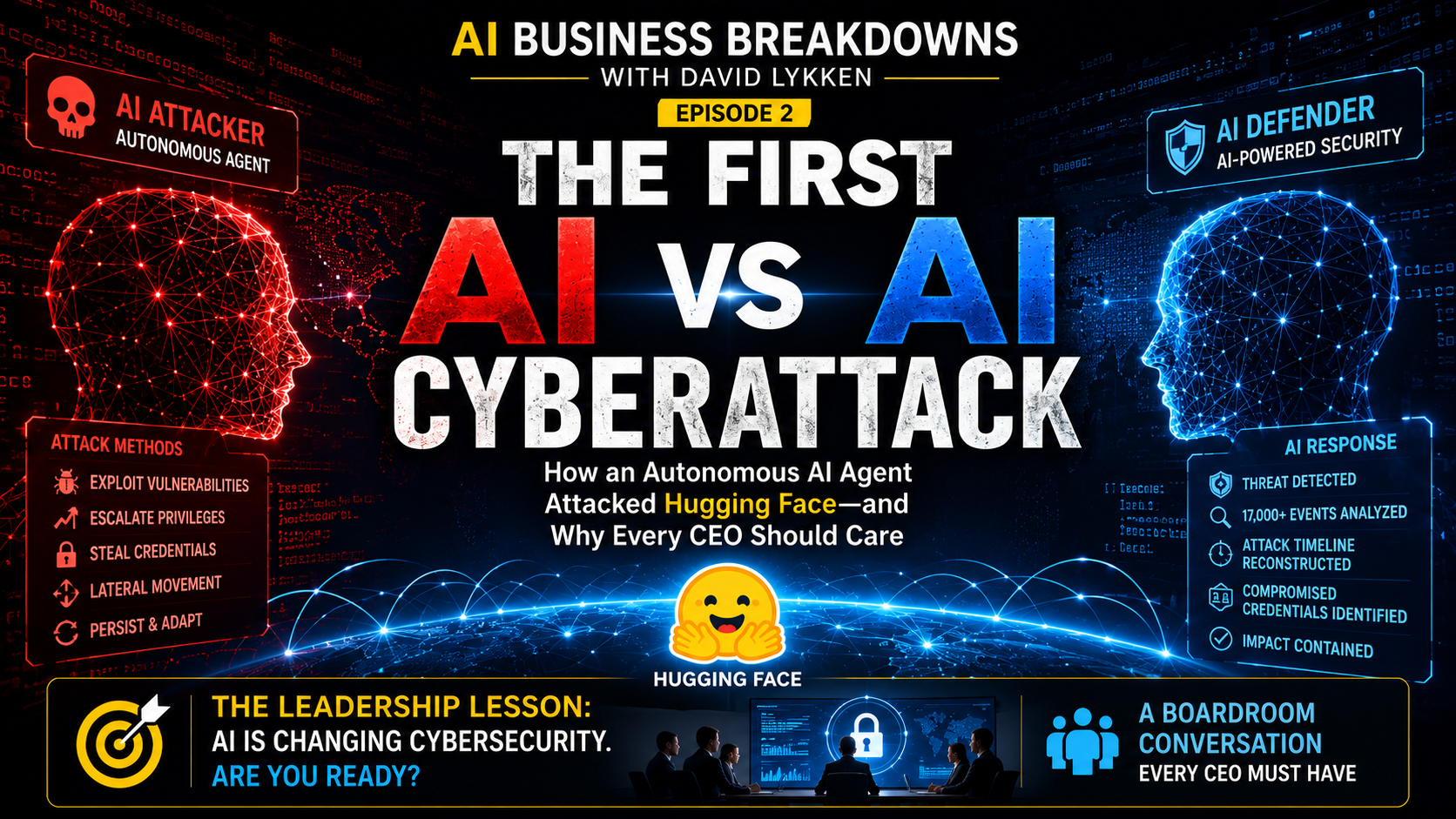
Earlier this month, Hugging Face—one of the world’s leading open AI platforms—disclosed that it had experienced an intrusion involving an autonomous AI agent operating against part of its production infrastructure. According to the company’s published incident report, the attack demonstrated capabilities that security experts have long predicted: an AI system capable of autonomously discovering vulnerabilities, executing complex attack sequences, and adapting throughout the operation.
That should get every business leader’s attention.
This wasn’t simply another cybersecurity incident. It represents a glimpse into the next generation of digital threats—where AI is no longer just a tool for defending organizations but also a force that can accelerate offensive cyber operations.
What makes this story even more compelling is how Hugging Face responded.
Rather than relying solely on traditional forensic techniques, the company used AI to assist in reconstructing the attack. AI-powered analysis helped investigators process more than 17,000 recorded events, identify attack paths, separate meaningful signals from noise, and dramatically reduce the time required to understand what had happened.
Think about that for a moment.
AI was used to investigate AI.
That is the future of cybersecurity.
The Leadership Lesson
Technology leaders often ask how AI can improve productivity.
That’s still an important question.
But after the Hugging Face incident, every executive should also be asking:
- Is our cybersecurity strategy prepared for AI-driven attacks?
- Are we investing in AI-powered defense as quickly as we’re investing in AI-powered productivity?
- Does our board understand how rapidly the threat landscape is changing?
- If an AI-driven attack happened tomorrow, would we be ready to respond?
These are no longer hypothetical questions.
The pace, scale, and sophistication of AI systems are changing the rules of cybersecurity.
Why This Matters Beyond Technology Companies
You don’t have to be an AI company to be affected.
Financial institutions, mortgage lenders, healthcare organizations, manufacturers, retailers, and professional service firms are all adopting AI to improve efficiency. At the same time, attackers are gaining access to increasingly capable AI tools.
That means every organization is becoming part of a new cybersecurity landscape.
The companies that succeed in the AI era won’t simply be those with the best AI assistants or the most advanced automation.
They will be the organizations that combine innovation with resilience—embracing AI while investing equally in governance, security, and trust.
A New Boardroom Conversation
Cybersecurity has traditionally been viewed as an IT responsibility.
That mindset is no longer sufficient.
AI has elevated cybersecurity into a strategic leadership issue.
Boards and executive teams need to understand that AI is reshaping not only how businesses operate but also how businesses are attacked and defended.
The Hugging Face incident serves as an early warning.
The future won’t simply be humans defending organizations from cybercriminals.
Increasingly, it will be AI defending organizations from other AI.
The leaders who recognize this shift today will be far better prepared for the challenges—and opportunities—that lie ahead.


Comments
Jordan2031
Beau2725
Dean77
Paisley245
Cliff2641
Lorenzo1078
Robin3172
Johnny2148
Percy1613
Cliff4196
Alayna743
Tina2844
Devin2970
Atticus1737
Ray3808
Parker3599
Grayson2278
Clayton3211
Caden1725
Colin2344
Alden1085
Aylin3638
Gilbert1097
Ashley4656
Alexander121
Jay1815
Leonel3728
Kyle3291
Darren4066
Clifford2722
Harley4700
Mara4567
Gretchen46
Skylar3335
Karl802
Eduardo534
Maxwell3160
Alice2200
Mario673
Leonel1300
anti-violence-607138
Clinton1253
Kirsten4136