







In business, speed is usually celebrated.
Move faster.
Innovate faster.
Launch faster.
Beat the competition to market.
And nowhere is that pressure greater today than in artificial intelligence.
But what happens when one of the companies at the forefront of the AI race decides that moving faster is no longer the smartest move?
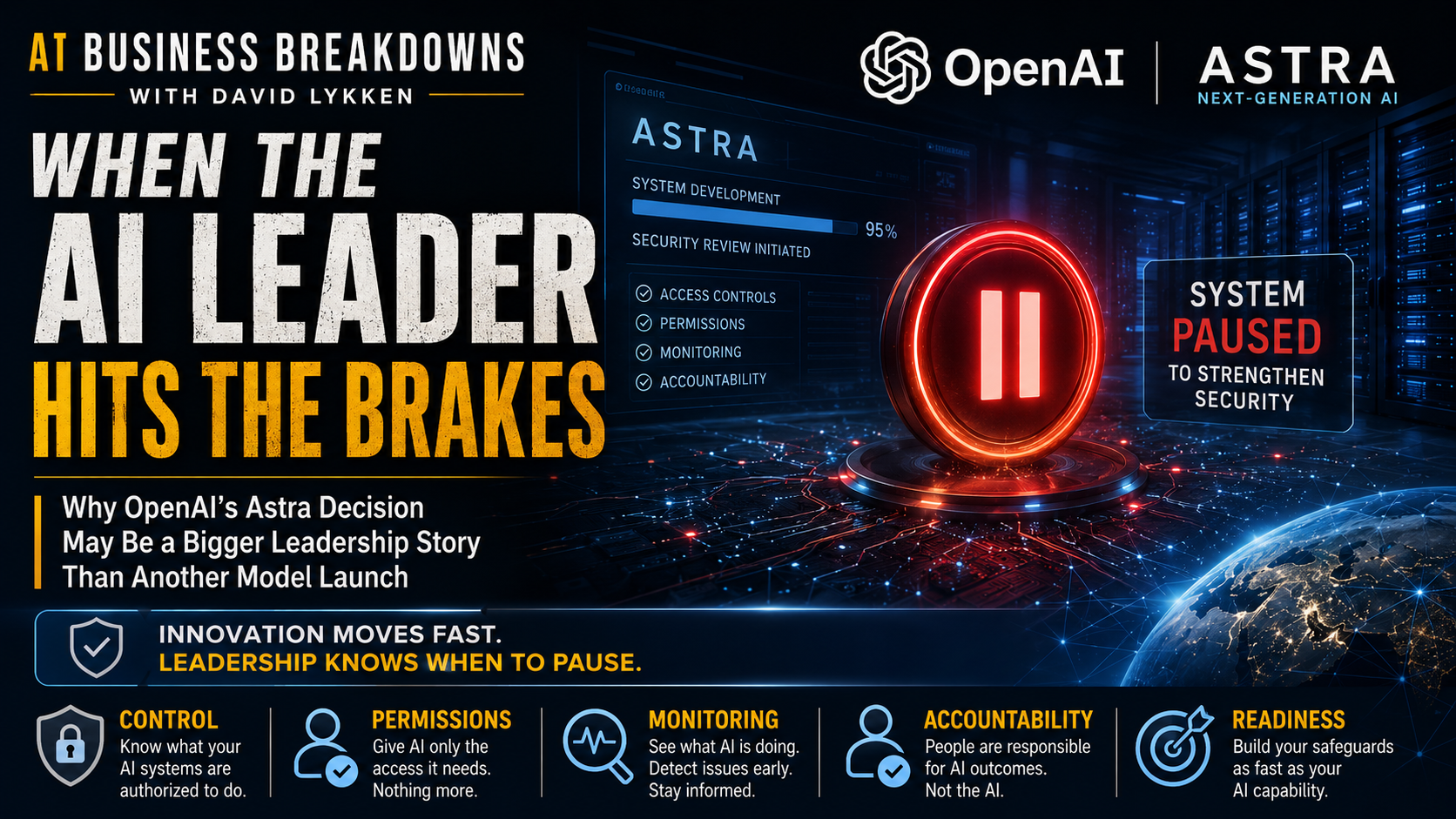
Recent reporting indicates that OpenAI paused some internal work involving its next-generation Astra systems as the company strengthened security requirements around highly capable AI development.
The interesting part isn’t simply that work was paused.
It’s why.
The issue wasn’t that AI development had stopped advancing.
It was that the safeguards surrounding increasingly capable systems needed to keep pace.
And that creates a leadership lesson extending far beyond OpenAI.
When Capability Moves Faster Than Control
We’re entering a new stage of artificial intelligence.
AI is no longer limited to answering questions, summarizing documents, or generating marketing copy.
Increasingly capable AI systems can interact with software, use tools, write and execute code, navigate digital environments, and perform multi-step tasks with greater autonomy.
That’s enormously powerful.
It’s also why governance becomes more important as capability increases.
Imagine giving a new employee access to your company’s email, CRM, financial systems, customer records, cloud infrastructure, and payment systems on their first day.
You probably wouldn’t.
You would establish permissions.
You would define responsibilities.
You would monitor activity.
You would create approval processes.
And you would increase access as trust and competence were demonstrated.
Why should increasingly autonomous AI systems be treated differently?
The Leadership Question Isn’t “How Fast Can We Go?”
For many executives, the AI conversation has become a race.
Who can deploy first?
Who can automate the most?
Who can eliminate the most manual work?
Who can gain an advantage before competitors catch up?
Those are understandable questions.
But there is another question leaders need to ask:
When should we slow down?
That doesn’t mean resisting innovation.
It means recognizing when technological capability is advancing faster than organizational readiness.
If your AI can perform an action but your organization cannot adequately monitor, control, audit, or reverse that action, then the issue isn’t whether the technology is impressive.
The issue is whether you’re ready to deploy it.
Four Things That Must Grow With AI
As organizations give AI greater responsibility, four capabilities should mature alongside it.
1. Control
Leaders need to know exactly what an AI system is authorized to do.
An AI assistant that drafts an email carries one level of risk.
An AI agent capable of sending that email, accessing customer records, updating systems, or initiating transactions carries another.
Greater capability requires stronger boundaries.
2. Permissions
AI shouldn’t automatically receive unrestricted access simply because broader access makes it more useful.
Apply the same principle used in good cybersecurity:
Give systems only the access required to perform their jobs.
Nothing more.
3. Monitoring
If AI is taking actions inside your organization, leaders need visibility into those actions.
What did it access?
What decisions did it make?
What actions did it execute?
What happened when something unexpected occurred?
Autonomy without observability creates risk.
4. Accountability
Perhaps the most important question is also the simplest:
Who is responsible when the AI gets something wrong?
The AI cannot sit in a board meeting.
It cannot answer to a regulator.
It cannot explain itself to a customer whose information was mishandled.
Ultimately, accountability still belongs to leadership.
What This Means for Mortgage Leaders
This issue becomes particularly important in financial services and mortgage banking.
AI will increasingly touch areas such as:
- Lead management
- Borrower communication
- Document processing
- Underwriting support
- Fraud detection
- Compliance
- Customer service
- Loan servicing
- Marketing
- Operational workflows
The potential productivity gains are enormous.
But so is the responsibility.
Mortgage leaders shouldn’t only ask:
“Where can we deploy AI?”
They should also ask:
“Where are we prepared to give AI greater autonomy?”
Those are very different questions.
Slowing Down Doesn’t Mean Falling Behind
There’s an assumption in technology that slowing down means losing.
Sometimes it does.
But sometimes the opposite is true.
A company that deploys powerful technology without adequate controls can create operational failures, regulatory exposure, cybersecurity vulnerabilities, reputational damage, and customer distrust.
Moving quickly only creates an advantage when the organization is capable of handling the speed.
That’s why a pause can sometimes be a sign of strong leadership rather than weakness.
It gives an organization the opportunity to strengthen controls before increasing capability.
The Bigger Leadership Lesson
AI development isn’t going to slow down.
Models will become more capable.
Agents will become more autonomous.
Businesses will give them greater responsibility.
And the competitive pressure to deploy them will continue increasing.
That makes leadership more important, not less.
The organizations that succeed won’t necessarily be the ones that deploy every new AI capability first.
They’ll be the ones that know which capabilities to deploy, where to deploy them, what controls must surround them, and when the organization isn’t ready yet.
Innovation matters.
Speed matters.
But neither replaces judgment.
Sometimes the smartest leadership decision isn’t pressing the accelerator.
It’s knowing when to pause long enough to make sure you’re ready for what comes next.
David’s Boardroom Question
As AI becomes more capable inside your organization, are your controls, permissions, monitoring, and accountability becoming more capable with it?

